


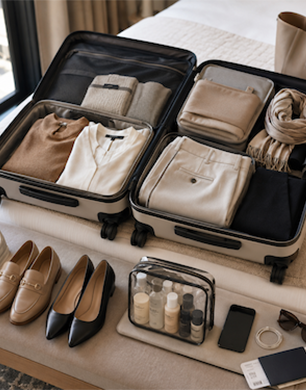
 There is a certain kind of traveller who arrives at their destination looking effortlessly put together, never wrestles an overstuffed suitcase through airport corridors, and somehow always has exactly the right outfit for every occasion. This is not luck. It is the result of a packing system that has been refined over many trips and many hard lessons. This guide covers the principles, the methods, and the practical details that separate elegant, efficient packing from the panic-driven approach most of us start with.
Start with the Wardrobe, Not the Suitcase
The most common packing mistake is opening the suitcase first and filling it with things that seem relevant. The better approach is to plan your outfits before a single item goes in the bag.
Write down each day of the trip and what you will be doing. A five-day city break might look like: two casual sightseeing days, one evening dinner reservation, one day trip with walking, and one travel day. From that framework, build outfits rather than individual items. If a piece cannot be worn at least twice across the trip, it does not earn its place.
The capsule wardrobe principle applies here more usefully than anywhere else. Three to four base colours that work together allow you to mix and match pieces without ending up with a suitcase full of things that do not coordinate. Neutral foundations with one or two accent pieces give you variety without the weight.
The Carry-On Challenge
For trips of up to ten days, a well-chosen carry-on is almost always sufficient. Avoiding checked luggage changes the rhythm of travel entirely: no waiting at baggage claim, no risk of lost bags, and the freedom to move immediately after landing.
The standard carry-on dimensions accepted by most airlines, including British Airways, EasyJet, and Ryanair, vary significantly. Know your airline’s exact dimensions before buying a bag. A 40-litre capacity is the practical sweet spot for most stylish travellers who pack thoughtfully.
Packing cubes are the infrastructure of good carry-on packing. They compress clothing, keep categories organised, and make it possible to find things without unpacking everything. Compression packing cubes, which use a one-way zip to reduce volume, work particularly well for knitwear and casual trousers.
Fabrics That Travel
The choice of fabric determines how your clothes look after twelve hours in transit, three days on a hanger in a hotel wardrobe, and however many wears between laundry opportunities.
Merino wool is the fabric that experienced travellers consistently return to. It regulates temperature across a surprising range of climates, resists odour naturally, and recovers from folding and rolling without visible creasing. A merino base layer, a merino jumper, and merino socks can cover a substantial portion of a trip’s clothing requirements.
Ponte fabric and technical knits sit further up the style register and travel equally well. Many contemporary fashion brands now produce pieces in travel-responsive fabrics that look like tailored clothing but behave like athletic wear.
The fabrics to avoid: linen wrinkles enthusiastically and takes up disproportionate space. Structured cotton shirts crease in transit and require ironing that hotel irons rarely deliver properly. Sequins and heavily embellished pieces are difficult to pack without damage.
The Shoe Calculation
Shoes are the weight problem in most suitcases. Three pairs is the practical maximum for most trips: one walking shoe or trainer, one versatile mid-heel or loafer that works for both daytime and evening, and one flat sandal or pump depending on climate. Wearing the bulkiest pair on travel days keeps luggage weight down.
Shoe bags, or simply shower caps from the bathroom, protect clothing from contact with soles.
Toiletries and the 100ml Rule
For carry-on-only travel, the 100ml liquid restriction applies to every liquid, gel, and cream. A refillable silicone bottle set in 30ml, 50ml, and 100ml sizes covers most needs. Solid alternatives, including solid shampoo bars, conditioner bars, and solid perfume, have improved dramatically in quality over the past few years and entirely eliminate the liquid restriction for those categories.
The items most worth prioritising in the full 100ml allowance are products that genuinely do not have dry alternatives: prescription medications in liquid form, high-SPF facial sunscreen in a formulation you trust, and any specialist skincare with an active ingredient that does not translate to a solid format.
The Digital Preparation That Most Stylish Travellers Overlook
Packing beautifully and then arriving at your destination without mobile data is a logistical problem that undermines everything else. Since Brexit, UK travellers no longer have guaranteed free roaming across Europe, and outside Europe the daily charges from UK carriers can reach £5 to £15 per day.
Understanding what an esim is and activating one before departure is the connectivity equivalent of a well-packed suitcase: it removes a variable that causes unnecessary friction. Holafly’s travel eSIM covers over 200 destinations, activates via QR code from home before you leave, and keeps your UK number active on your physical SIM for calls and texts simultaneously. No daily charges, no SIM swapping, and no queuing at airport phone shops.
The Night Before Checklist
The evening before a flight is when most packing mistakes happen, because it is rushed. Building a permanent packing list, either on paper or in a notes app, that is reviewed and ticked off for every trip removes the cognitive load of trying to remember everything under time pressure.
The list should be divided into categories: clothing by type, toiletries, electronics and cables, documents, and miscellaneous. The eSIM activation and the offline map download for your destination both belong in the electronics section, not as an afterthought at the airport.
What to Leave Behind
Every experienced traveller has a category of things they once packed and never used. The fourth pair of shoes. The evening dress for an occasion that did not arise. The full-size hairdryer when every hotel has one.
The mental reframe that helps most is this: everything you leave behind is weight you do not carry through airports, up hotel stairs, and through city streets. The things you genuinely need but forget can almost always be bought at a pharmacy or supermarket at your destination. The things you pack and do not use cannot be unpacked mid-trip.