


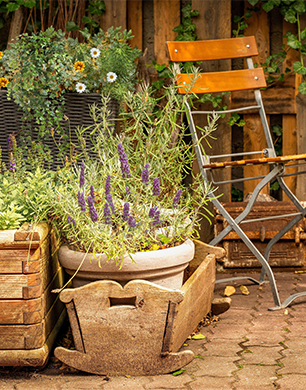
Photo Credit: Gundula Vogel via www.pexels.com
London gardens average around 100 square metres. The national average is 255. Less than half. If you’ve ever stood in your own garden feeling like you’re being asked to do too much with too little, that’s not you being unreasonable. That’s just the maths of where you live.
A small garden isn’t a failed big one. It’s its own thing, with its own logic, and comparing it to a plot three times the size just makes everyone miserable for no reason.
Every metre has to work for its keep, yes. But that’s not a punishment. It’s a filter. Half-hearted ideas get weeded out fast, and what’s left is usually better anyway.
Think Vertically
Most of the wasted space in a small garden is above head height. Nobody looks up.
A climbing plant on a trellis gives you way more presence per square centimetre than a flower bed ever will. Wall planters do something similar, and crucially they leave the floor free for actual use rather than just looking nice.
That’s the bit people miss. Floor space is what makes a garden usable. Not the plants themselves, the room around them.
Storage’s the same story. Get the tools off the ground, onto a hook, onto a shelf, wherever, and there’s suddenly room to sit down without knocking a watering can into someone’s lap.
Choose Furniture That Serves More Than One Purpose
A nice dining set feels like the reward after all the hard work. But in a tight garden, furniture with a single job is a bit of a luxury, if we’re honest.
A storage bench does two jobs. Seating, and somewhere to shove the stuff you don’t want visible. Folding furniture helps too, if you only host occasionally. Depends on the house, really.
Some people are out there every night, in which case something fixed and solid probably beats a chair you’re wrestling open and shut constantly.
Smaller dining sets, built for two or four, sit far more naturally in a tight plot than a table meant for eight that ends up eating the whole patio.
Consider a Compact Garden Room
Something’s shifted here lately. More people are looking at small garden rooms as a genuinely useful bit of extra space, not a luxury add-on. An office. A hobby corner. Somewhere to think that isn’t the spare bedroom with a desk crammed in.
Proportion decides everything. Get it wrong and a garden room too big for its plot swallows the whole garden, makes the rest feel like scraps left over. Get it right and it just becomes part of the place.
Windows do a lot of the heavy lifting too. Big glazing keeps the room feeling open instead of like a box, and it pulls the greenery outside into the room rather than shutting it out.
Funny how much a well-sized garden room can add without really taking much away.
Use Colour and Materials Strategically
Consistency is one of those things nobody notices until it’s gone. Matching fencing, planters, and furniture tones turns a garden into one space instead of a scatter of separate weekend decisions.
Light, pale surfaces bounce daylight around, which matters a lot when you’re boxed in by fences or a neighbour’s wall.
Timber adds warmth without shouting for attention, and it’s part of why Palmako timber buildings tend to weather into a colour that just sits well next to planting instead of fighting it.
Create the Illusion of More Space
A clean line of sight from the back door to the far fence is an old trick, and people skip it constantly. The eye travels uninterrupted; space feels bigger. Doesn’t matter what the tape measure says.
Layered planting, low near the house, taller further out, gives depth rather than just more stuff. Mirrors, used carefully and pointed at greenery rather than a fence, genuinely trick the eye. One works well. Three starts to look like a fairground mirror maze, which is not the vibe.
Clutter kills all of this fast. Not mess exactly. Just too many small decorative bits fighting for the same glance.
Make Corners Useful
Corners get ignored constantly and it’s a shame, because they’re often the most sheltered patch in the whole garden. A bench in the corner with something growing overhead becomes an instant little nook.
Storage tucked away answers the endless question of where the bins go. A small lean-to or compact shed fits a corner better than it fits anywhere else, honestly.
Connect the Garden to the House
Don’t treat the garden like a separate job from the house it’s attached to. Matching flooring tones between inside and out, similar colours on doors and fencing, one thread running through both spaces – it all adds up to the garden feeling like part of the house instead of something stuck on the end of it.
The Bottom Line
A smaller garden isn’t fewer possibilities. It’s fewer wasted ones. Plan it properly and the size stops mattering nearly as much as people assume.