


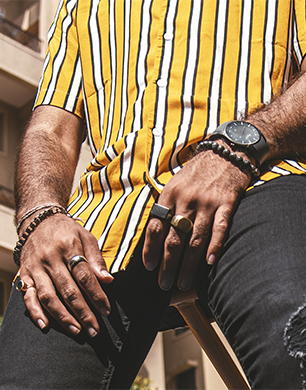
Photo Credit: Animesh Srivastava via www.pexels.com
Most men who wear jewellery well didn’t plan it that way. One piece got picked up, worn until it stopped feeling like an accessory, and then another followed. Trace a decent collection back to its start and the first thing a man bought tends to sit on the wrist.
There’s a reason for that, and it isn’t complicated.
The Wrist Gets Seen Whether He Means It or Not
A man’s hands are busy all day. He’s passing a card across a bar, holding a coffee, resting an arm on the table during a meeting that ran twenty minutes past its useful end. The wrist moves through all of it, sliding in and out of a shirt cuff, catching light for a second and then gone. Whatever sits there gets noticed in fragments, which is a gentler way to be noticed than a chain lying flat against the chest with nowhere to hide.
That fragmentary quality does more work than people credit it with. A ring announces itself. A necklace, depending on how it’s worn, can read as a statement before a man’s said a word. The wrist lets him ease in. He can wear something there for a month before anyone comments, and by then it’s already his.
Honestly, that’s why so many first purchases end up there. A man can test whether jewellery suits him at all without committing to much.
Why Gold?
Gold does something on skin that steel and leather don’t. It warms up. It picks up the tone of whoever’s wearing it rather than sitting on top like a cold object. A man with a deep, darker complexion will find that gold settles into something that looks like it belongs to them.
There’s the matter of how it ages, too. Gold can tarnish and keep going. Men’s gold bracelets, even when worn daily for five years, look better at year five than they did on the day they arrived, and that’s a rare thing to be able to say about anything a man buys.
The First Purchase Is Always a Bit Hard
Nobody buys their first bracelet feeling sure of themselves. There’s a whole internal back-and-forth (is this too much, will people assume he’s trying too hard, does it suit a man who mostly lives in jumpers and jeans) and most of it burns off within a week of wearing the thing.
The move a lot of men land on is starting plain. A simple curb chain or a beaded design in gold does more than anything loud ever manages. It sits next to a watch without fighting it. It works with a suit, and it works with a Sunday spent doing absolutely nothing, and because it isn’t shouting, it never looks wrong.
Through the Ordinary Days
Part of what makes a wrist piece stick is how well it survives ordinary life. Rings come off for the gym and get left in a locker. A necklace disappears under a jumper by mid-morning. The bracelet tends to stay on through it all, and a piece that never leaves the wrist stops feeling like an accessory and starts to feel like part of the man wearing it.
Gold handles water and daily wear better than most men expect. It goes in the shower and comes out fine. It takes a knock against a car door and shrugs it off. So there’s rarely a good reason to take it off, and the one that never comes off ends up in every photo from a decade without anyone having planned that.
From One Piece
Once the first bracelet has earned its spot, the rest follow on their own. A man starts noticing other men’s wrists (which, fine, sounds a bit strange, but it happens). He clocks how someone’s stacked two thin bands together, or paired gold against a battered watch strap, and the ideas pile up from there.
Stacking is where it gets good anyway. Two or three pieces of different widths, all kept in the same metal, so nothing clashes, builds something that looks thought-through without looking try-hard. Over a couple of years, a man ends up with a small rotation he barely thinks about, grabbing whichever suits the occasion.
The wrist is where most men who understand jewellery styling began, and the reasons aren’t a secret. It’s forgiving, gold does its finest work there, and a man can live with a bracelet for weeks before deciding whether it stays. Most of the time, it stays.